

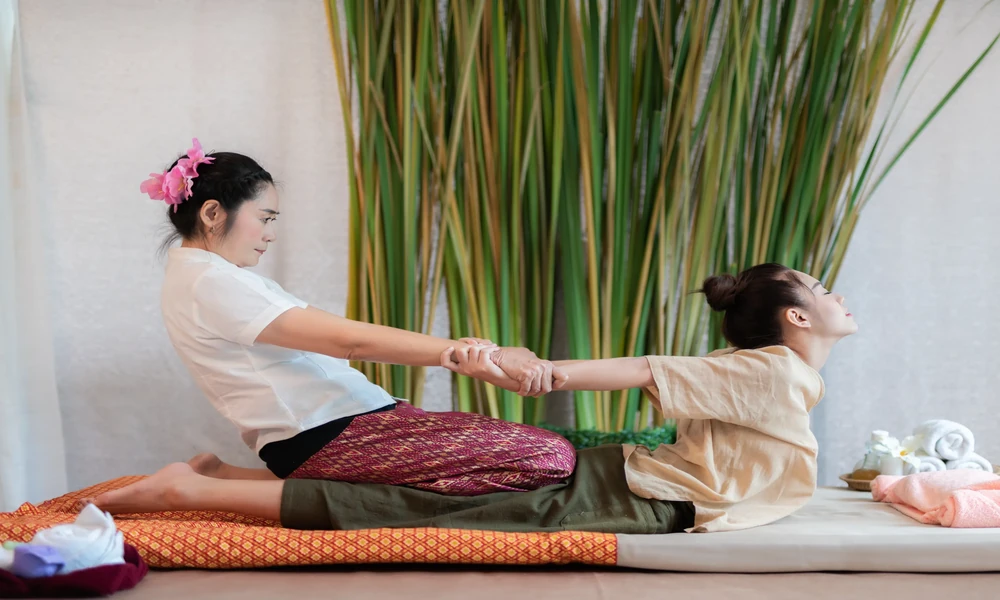
A thai massage spa menu puts the treatment beside hot stone and aromatherapy, priced by the hour like everything else. The method itself is far older than the menu. A few things about a session only make sense with that background. The cotton clothes. The start at the feet. The few seconds a therapist spends with palms pressed together before kneeling down.
The Doctor in the Prayer
That short pause is a prayer. Many therapists dedicate it to Shivago Komarpaj, the Thai name for Jivaka Komarabhacca. Buddhist texts describe him as a doctor who treated the Buddha around 2,500 years ago, and Thai tradition calls him the father of the practice.
The real origins are harder to pin down. Indian medicine shaped it. So did local folk healing. Some of the pressure techniques look Chinese. Paper records would help, but most are gone.
Ten Lines Out of 72,000
Thai medicine pictures the body as crossed by channels called sen. Old texts count 72,000. Ten matter most in practice. They are said to start near the navel and run out to the hands, the feet and the openings of the head.
Pain was explained as a blockage somewhere along a line. Pressing the line was meant to clear it.
That idea shapes the whole massage. Thumbs move along a path, one press after another, instead of rubbing in circles. The work starts at the feet because several main lines end there.
No anatomy textbook shows sen lines. Many of the points along them sit on tight muscle bands and over nerves, though, and pressing those points eases stiffness whatever the theory behind it.
Lessons Carved in Stone
Temples were the first schools. Monks treated villagers in temple grounds. Students learned by watching and copying, and very little was written down.
On royal order, diagrams of the body showing sen lines and pressure points were carved into stone tablets and set into the walls of a temple in the capital. Anyone walking past could study them.
What Spas Changed
A modern thai massage spa keeps the method and changes almost everything around it.
- Private rooms with dim lights replaced the open halls, where a dozen mats once lay side by side.
- Low beds sit in some rooms now, for guests who can’t get down to a floor mat.
- Treatments are sold in blocks of 60, 90 or 120 minutes. The old practice ran as long as the problem needed.
- Steamed herbal compresses, bundles of plai root and lemongrass tied in cloth, are sold as an extra.
- Combined packages add aromatherapy oil, which classic Thai massage never used.
Recognition Beyond the Spa
The listing covers the knowledge and the way it passes from teacher to student. It doesn’t name any school or spa.
Training is formal now, with courses and certificates. The order of learning hasn’t moved much, though. Students study the sen lines first. Stretches come later, once the lines are known by touch
